

September was for building holiday shops. October was for launching them. November is when they sell, and when most of the industry stops taking holiday orders.
Traditional lead times end the season in early November. Your clients’ spending doesn’t end with it. Gifting decisions, year-end budgets, and late holiday orders keep coming through December. Whoever can still say yes gets them.
A launched shop isn’t a finished job
Most holiday shops get one big moment: the launch email. Orders come in, then traffic slows. Not because people stopped wanting gifts — because nobody reminded them.
The usual gaps:
- The client sent one announcement in October and moved on
- Employees with gift codes haven’t used them yet
- Clients who passed in September assume it’s too late now
November is for the second push.
Three ways to sell holiday shops in November
1. Give every live shop a second push
The first announcement gets the early shoppers. The second one gets everyone else. Send each client a short reminder they can forward to their people, plus a fresh flyer for the newsletter, the break room, or the team chat.
Right after Thanksgiving is a good moment. People are back at their desks, and December suddenly feels close.
“Quick reminder before December gets busy — your holiday shop is live. Pick what you want, in your size, and it ships straight to you. Here’s the link: [link]”
2. Make the late pitch
The clients who said “not this year” in September are worth a second ask. A lot changes in two months. Budgets free up. Plans firm up. Someone realizes the gifts never got handled.
- Corporate clients who passed earlier. Lead with gift codes again. Fixed budget, nothing to sort or hand out, and every employee picks their own gift.
- Clients with budget left. Year-end money expires December 31. A holiday shop gives them a way to spend it without boxes stacked in the office.
- Schools and teams. Winter sports and holiday break put spirit wear on gift lists. One shop link reaches every family.
- Nonprofits. Year-end is one of the biggest giving windows of the year. A holiday shop turns it into a merch fundraiser with nothing to buy upfront.
3. Say yes to late holiday orders
Some of the best orders of the season show up late. A client resurfaces in a hurry, and every vendor they’ve called has already stopped taking holiday orders.
Don’t quote a lead time. Build the shop on the spot, turn their logo into seasonal designs, and reply with the link the same day.
“Good news — you’re not too late. Your holiday shop is live: [link]. Orders produce in 1–2 days, so send it to your people today and the gifts start moving.”
Why November pays off
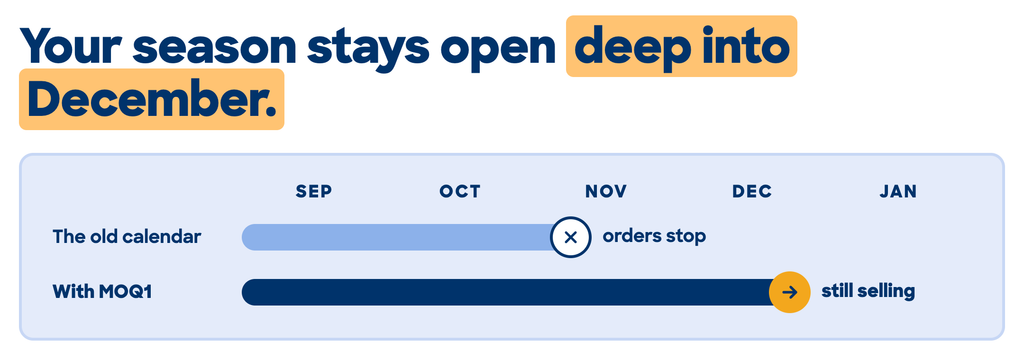
For most of the industry, November is where the holiday season ends. Production needs weeks of runway, so orders stop early and December becomes the month you watch demand you can’t touch.
Most distributors don’t lose holiday orders. They pre-decline them.
MOQ1 removes the runway. Shops launch in seconds. Every order produces on demand in 1–2 days. No minimums. No inventory. Your season stays open deep into December — right when clients are most ready to buy.
Next up: December, and the use-it-or-lose-it budgets that come with it.
Your November checklist
- Every live shop gets a second announcement
- Every client who passed in September gets a second ask
- Every late request gets a shop link the same day
- Every client knows you’re still taking holiday orders
November goal: keep every shop selling and say yes to every late order.
The Holiday Shops Playbook has the full season — who to pitch, what to say, and what to do when the late requests land.
Get the Holiday Shops Playbook →
Read more: Holiday Shops: October Is Launch Month · Everything You Need to Run Holiday Shops This Season · Build a Holiday Program Before They Ask